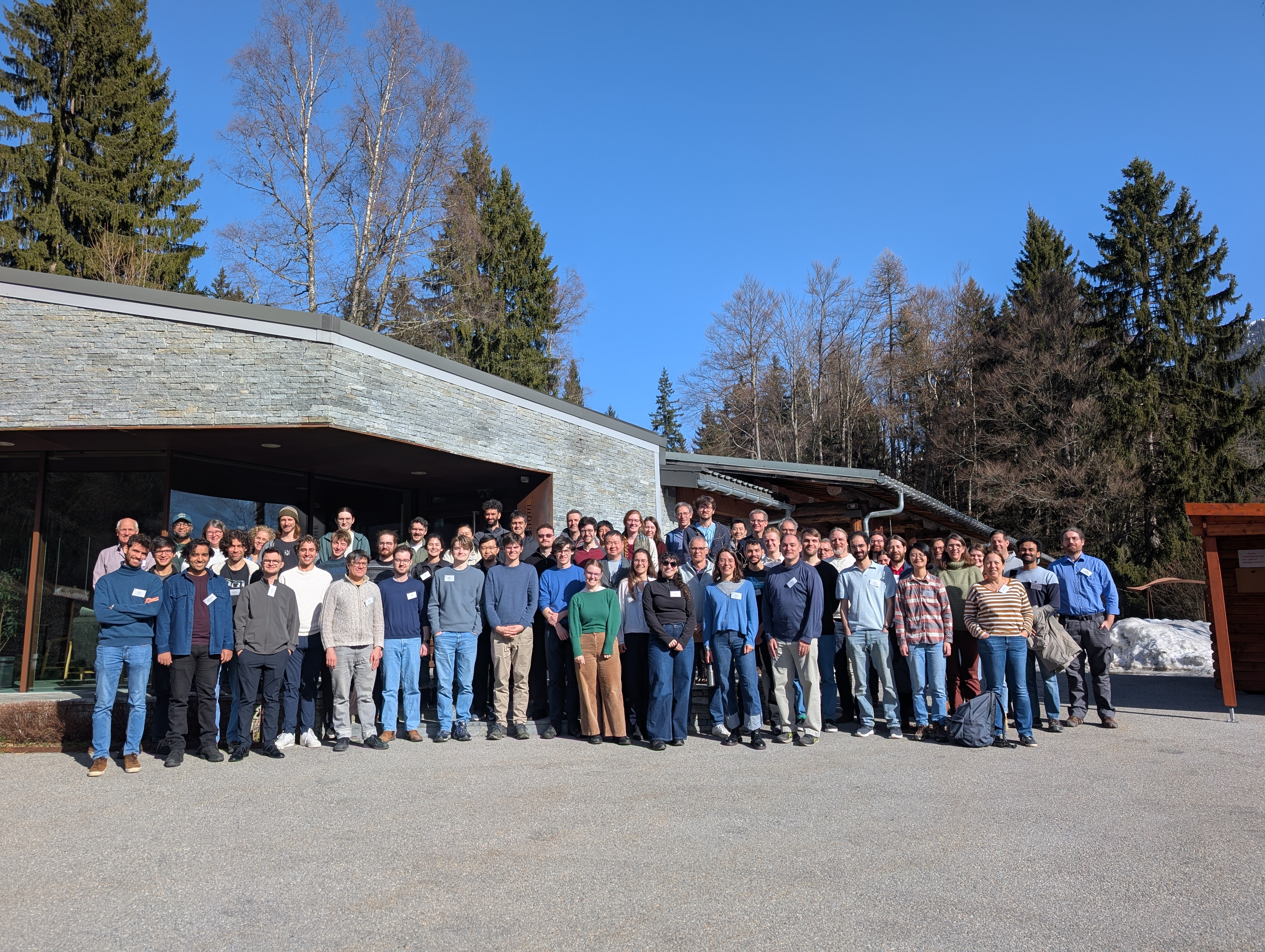
EDMs2026 : WE-Heraeus Workshop

Europe/Paris
Amphi (École de Physique des Houches)

Amphi

École de Physique des Houches

149 Chem. de la Côté, 74310 Les Houche https://houches.univ-grenoble-alpes.fr/
Description

EDMs 2026  (Electric Dipole Moments 2026): Complementary Experiments and Theory Connections

Please ignore scam messages asking you to confirm reservation or hotel booking! (Or at least check with the organizers via their usual contact details.) Nothing needs to be paid before you arrive at Les Houches.

This workshop is supported by the Wilhelm and Else Heraeus-Foundation

The search for permanent electric dipole moments (EDMs) of subatomic particles provide a powerful probe of CP violation and physics beyond the Standard Model. This second edition (following on a very succesful first workshop at ECT* in 2023), is part of a European initiative to strengthen connexions between experiment and theory, bringing together complementary methods from nuclear, particle, atomic and molecular physics, as well as advanced theoretical calculations.

While many speakers have already confirmed availability, the detailed program is still being defined. We seek to represent as broad as possible a cross-section of theoretical and experimental activities in relation to permanent electric dipole moments, and also welcome participation from allied fields such as magnetic dipole/quadrupole moments, or hadronic parity violation, that can be interpreted in a common framework.

Our central scientific questions in relation to EDMs include the following:

  • What is are the most driving modern motivations for EDM searches, in light of challenges to electroweak baryogenesis?
  • Which experiments most complement each other in terms of their methods? In terms of their constraining power?
  • What theoretical inputs are most needed for completing, or reducing uncertainty in, the interpretation of experimental results?
  • Which experimental systems are now facing new challenges, and which ones show the most potential for improvements?
  • What new facilities and technologies are on the horizon, and which experiments or calculations could most profit from them?


An explicit additional goal is to assist the community in self-organizing for easier exchanges of knowledge and personnel, within and beyond Europe. In this view, we plan to incorporate moderated discussion sessions on key community-level challenges, including:

  • How can we best support advanced training for students across a geographically dispersed community, with relatively few students at any one institution?
  • Can we establish common ground for notations and physics conventions, to lower the barriers for understanding each other's work?
  • Are there methods or technologies under development (or already developed), for which awareness is lacking among people and groups who could use them?
  • How can we establish networks that ease the transfer of students and post-docs among groups, thus mitigating painful recruitment challenges of the last years?


Participants
Surveys
Questionnaire for "Feedback and follow-up"
    • 16:30 19:00
      Welcome, registration 2h 30m Amphi

      Amphi

      École de Physique des Houches

      149 Chem. de la Côté, 74310 Les Houche https://houches.univ-grenoble-alpes.fr/
    • 19:30 20:30
      Dinner restaurant

      restaurant

    • 08:45 09:00
      Welcome 15m Amphi

      Amphi

      École de Physique des Houches

      149 Chem. de la Côté, 74310 Les Houche https://houches.univ-grenoble-alpes.fr/
      Speakers: Skyler Degenkolb, Guillaume Pignol (LPSC), Stéphanie Roccia (LPSC Grenoble)
    • 09:00 09:30
      Global analysis of EDMs and electronic structure 30m Amphi

      Amphi

      École de Physique des Houches

      149 Chem. de la Côté, 74310 Les Houche https://houches.univ-grenoble-alpes.fr/

      Obtaining rigorous bounds on CP-violation at the fundamental level is complicated by the contributions of several subatomic sources to the net P,T-odd electric dipole moment (EDM) of atoms and molecules. Consequently, several experiments of complementary sensitivity to these individual sources are required. I will discuss a simply-applicable qualitative model for analyzing the effect of different atomic and molecular species in a global analysis of CP-violation. The focus will be on systems with closed-shell electronic shells, actinide molecules in high charge states and polyatomic molecules. We will compare phenomenological scaling laws with accurate density functional theory and coupled cluster calculations to analyze the influence of relativistic and chemical enhancements as well as electron correlation effects. In conclusion we will infer the most promising directions for EDM measurements from an electronic structure perspective.

      Speaker: Konstantin Gaul (Johannes Gutenberg-University Mainz)
    • 09:45 10:15
      Towards searching for nuclear CP-violating physics using triatomic molecules 30m Amphi

      Amphi

      École de Physique des Houches

      149 Chem. de la Côté, 74310 Les Houche https://houches.univ-grenoble-alpes.fr/
      Speaker: Luke Caldwell (University College London)
    • 10:30 11:00
      coffee 30m coffee room

      coffee room

    • 11:45 12:15
      Determination of the nuclear Schiff moment of Ac-227 within the nuclear density functional theory (nuclear DFT) framework 30m Amphi

      Amphi

      École de Physique des Houches

      149 Chem. de la Côté, 74310 Les Houche https://houches.univ-grenoble-alpes.fr/

      Parity- and time-reversal-violating nuclear forces induce the P-odd nuclear moments, particularly the nuclear Schiff moments [1]. The octupole deformation in the nucleus implies the presence of a partner state with the same intrinsic structure and angular momentum as the ground state but opposite parity at low excitation energy. Due to a small energy difference between the partner and the ground states, second-order perturbation theory suggests that the main contributions to the laboratory Schiff moments come from the expectation values of the Schiff operator and the PT-violating potential calculated between these two states, with the small energy denominator enhancing the laboratory Schiff moments [2]. A strong correlation between the calculated intrinsic octupole moments of even nuclei and the intrinsic Schiff moments of neighbouring odd nuclei in the light actinide region has been shown in previous nuclear DFT calculations by Dobaczewski et al. [2]. This correlation enabled them to estimate the intrinsic Schiff moments from the measured intrinsic octupole moments via linear regression, thereby reducing their uncertainties. They also conducted a similar analysis to compute the coefficients of the laboratory Schiff moments along with their uncertainties. In the present contribution, following the method described in Ref. [2], we determine the laboratory Schiff moment of Ac-227 [3, 4]. The deformed ground and partner states are obtained from the paired nuclear DFT calculations with broken time-reversal, signature, and parity using seven Skyrme energy density functionals. The uncertainties in the intrinsic and laboratory Schiff moments of Ac-227 are constrained by the measured octupole moment of Ra-226, which is 1080(30) efm^{3} [5]. [1] G. Arrowsmith-Kron et al., Rep. Prog. Phys. 87, 084301 (2024) [2] J. Dobaczewski, J. Engel, M. Kortelainen, and P. Becker, Phys. Rev. Lett. 121, 232501 (2018) [3] M. Athanasakis-Kaklamanakis et al., Nature (2025), in press [4] J. Dobaczewski et al., submitted to Annual Review of Nuclear and Particle Science (2025), arXiv:2511.04632 [5] H. Wollersheim et al., Nucl. Phys. A556, 261 (1993)

      Speaker: Herlik Wibowo (School of Physics, Engineering and Technology, University of York, UK)
    • 12:30 13:45
      Lunch 1h 15m restaurant

      restaurant

    • 13:45 14:15
      An improved limit on 171Yb electric dipole moment 30m Amphi

      Amphi

      École de Physique des Houches

      149 Chem. de la Côté, 74310 Les Houche https://houches.univ-grenoble-alpes.fr/

      Searches for permanent electric dipole moments (EDMs) probe new sources of CP violation beyond the Standard Model. The atomic EDM of 171Yb, which arises from its nuclear Schiff moment, is a promising candidate, but previous measurements were limited by noise and systematics induced by the optical dipole trap (ODT) that holds the atoms. Here we report a substantially improved search enabled by a dual-ODT configuration with orthogonal polarizations, and spin measurements for precise alignment of static and optical fields. By suppressing the dominant parity-mixing systematic and vector light-shift noise, we achieve a limit of |d(171Yb)| < 7.5 × 10⁻²⁸ e · cm (95% C.L.), which represents a 20-fold improvement over the previous work. We also present
      the first nuclear-structure calculation of the 171Yb Schiff moment. The experimental and theoretical advances combine to tighten constraints on CP-violating pion-nucleon couplings in a global analysis. Moreover, this work demonstrates a pathway toward future measurements in 225Ra, where nuclear deformation offers exceptional sensitivity to physics beyond the Standard Model.

      Speaker: Tian Xia (Hefei National Laboratory)
    • 14:30 15:00
      nEDM at TRIUMF 30m Amphi

      Amphi

      École de Physique des Houches

      149 Chem. de la Côté, 74310 Les Houche https://houches.univ-grenoble-alpes.fr/

      The TRIUMF UltraCold Advanced Neutron (TUCAN) Collaboration is developing a new room-temperature neutron electric dipole moment (nEDM) experiment, with the goal of achieving a measurement uncertainty of σ ≤ 1E-27 ecm, an order of magnitude below the current best limit. The challenge of modern nEDM measurements is in achieving the combination of long interaction times and high neutron densities necessary for a low statistical uncertainty. Efforts to overcome this challenge have largely focused on the use of ultracold neutrons (UCNs), which can be stored in a measurement cell for several minutes. To achieve the required UCN density, the TUCAN EDM experiment will utilize a new UCN source, using a unique combination of a spallation neutron source, warm heavy water and cold deuterium moderators, and a superfluid helium UCN converter. This source has undergone its first commissioning measurements in 2025. This presentation will discuss the TUCAN Collaboration's approach to measuring the nEDM, the results of the source commissioning, and the prospects for our nEDM measurement.

      Speaker: Sean Vanbergen (TRIUMF)
    • 15:15 15:45
      Ultracold molecules: fundamental physics, machine learning, and the need for data 30m Amphi

      Amphi

      École de Physique des Houches

      149 Chem. de la Côté, 74310 Les Houche https://houches.univ-grenoble-alpes.fr/

      Ultracold molecules provide some of the most powerful platforms for testing fundamental symmetries, including searches for permanent electric dipole moments and other signatures of physics beyond the Standard Model. I will discuss recent developments in high precision atomic theory, including our recent community code package release and neural network–assisted configuration interaction computations that accelerate large scale calculations for heavy atoms and ions relevant to EDM experiments. I will introduce our data portal project, an open, uncertainty quantified resource for precision atomic data, and outline our plans for a complementary molecular portal focused on curated bibliographies and spectroscopic data for key ultracold and EDM candidate molecules.

      Speaker: Marianna Safronova (University of Delaware)
    • 16:00 16:30
      coffee 30m coffee room

      coffee room

    • 16:30 17:00
      Interpreting eEDM searches in paramagnetic systems within SMEFT 30m Amphi

      Amphi

      École de Physique des Houches

      149 Chem. de la Côté, 74310 Les Houche https://houches.univ-grenoble-alpes.fr/

      The Electric Dipole Moment of the electron (eEDM) is typically investigated in experiments using paramagnetic molecules. However, the physical observable in these searches consists in a linear combination of CP-violating interactions, rather than the eEDM alone, which is commonly referred to as the equivalent EDM of the system. In this talk, I assume the presence of heavy CP-odd new physics and parametrize its effects in the Standard Model Effective Field Theory (SMEFT). I then examine how the SMEFT operators contribute to the equivalent EDM in paramagnetic systems, focusing on the leading dimension-six and one-loop contributions, while also including selected two-loop mixing effects and dimension-eight terms. I conclude by showing that eEDM experiments are sensitive to a wider set of SMEFT operators than previously recognized.

      Speaker: Marco Ardu (University of Valencia, IFIC)
    • 17:15 17:45
      EDM³ : polar molecules in solid noble gas 30m Amphi

      Amphi

      École de Physique des Houches

      149 Chem. de la Côté, 74310 Les Houche https://houches.univ-grenoble-alpes.fr/
      Speaker: Eric Hessels
    • 18:00 18:30
      ThF+ 30m Amphi

      Amphi

      École de Physique des Houches

      149 Chem. de la Côté, 74310 Les Houche https://houches.univ-grenoble-alpes.fr/

      Using HfF+ molecular ions, the second generation of the JILA eEDM experiment recently reported the most precise measurement of the eEDM, de = (-1.3±2.0stat±0.6syst) x 10-30 e cm [1,2]. To improve upon this precision, the third generation of the experiment plans to utilize ThF+ whose eEDM sensitive state promises coherence times of ~20 s [3,4,5]. We are currently studying a prototype of the third-generation experiment at a reduced scale to demonstrate the suitability of the ThF+ molecule for precision metrology. In this talk, we present our progress towards the realization of long coherence time, including cryogenics designs, field homogeneity requirements, and improved state detection techniques.

      Speaker: Sun Yool Park (JILA)
    • 19:30 20:30
      Dinner restaurant

      restaurant

    • 09:00 09:30
      Electroweak baryogenesis 30m Amphi

      Amphi

      École de Physique des Houches

      149 Chem. de la Côté, 74310 Les Houche https://houches.univ-grenoble-alpes.fr/

      Electroweak baryogenesis is a mechanims for the generation of the matter-antimatter asymmetry during the electroweak phase transition. As it happens at a relatively low energy scale, the responsible new physics could be probed experimentally, e.g. via EDM experiments. In this talk, I will give an overview of the status of Electroweak Baryogenesis with a focus on recent developments in the theoretical framework and EDM constraints.

      Speaker: Jorinde van de Vis (CERN)
    • 09:45 10:15
      who wants neutrons 30m Amphi

      Amphi

      École de Physique des Houches

      149 Chem. de la Côté, 74310 Les Houche https://houches.univ-grenoble-alpes.fr/
      Speaker: Kent Leung (ontclair State University)
    • 10:30 11:00
      coffee 30m coffee room

      coffee room

    • 11:00 11:30
      Towards CP-Violating Measurements Using Radium-Containing Molecules 30m Amphi

      Amphi

      École de Physique des Houches

      149 Chem. de la Côté, 74310 Les Houche https://houches.univ-grenoble-alpes.fr/

      Radium-containing molecules offer high sensitivity for measuring symmetry-violating nuclear properties due to the octupole deformation of the radium nucleus, the presence of closely spaced opposite-parity levels, and large effective internal molecular fields. In this talk, I will discuss ongoing efforts to produce, characterize, and control these molecules.

      Speaker: Ronald Fernando Garcia Ruiz (MIT)
    • 11:45 12:15
      who wants radioactive molecules? 30m Amphi

      Amphi

      École de Physique des Houches

      149 Chem. de la Côté, 74310 Les Houche https://houches.univ-grenoble-alpes.fr/

      Development of radioactive molecular beams at CERN-ISOLDE

      Speaker: Mia Au (CERN)
    • 12:30 13:45
      Lunch 1h 15m restaurant

      restaurant

    • 13:45 14:15
      molecules are better than atoms 30m Amphi

      Amphi

      École de Physique des Houches

      149 Chem. de la Côté, 74310 Les Houche https://houches.univ-grenoble-alpes.fr/

      Testing the Standard Model with Molecules A. Borschevsky The Van Swinderen Institute for Particle Physics and Gravity, University of Groningen, Nijenborgh 4, 9747 AG Groningen, The Netherlands Search for violation of fundamental symmetries provides a unique opportunity for testing the Standard Model. Atomic and molecular experiments offer a low energy and comparatively inexpensive alternative to high energy accelerator research in this field. As the observable effects (such as parity violation, PV) are expected to be very small, highly sensitive systems and extremely precise measurements are required for the success of such experiments. Atomic and molecular theory can provide crucial support for these experiments. An important task of theoretical research is to identify optimal molecular and atomic systems for measurements and to understand the mechanisms behind the enhanced sensitivity, which is strongly dependent on the electronic structure. Thus, accurate computational methods are needed in order to provide reliable predictions rather than estimates, and to obtain the various parameters that are required for the interpretation of the experiments. I will present the results of our recent investigations of molecules in the context of search for parity violating effects. An overview of the theoretical methods will be provided, including the recently developed scheme for assigning error bars on theoretical predictions. Then, I will focus on showcasing the different types of systems (diatomic, triatomic, and chiral molecules) that are promising candidates for experiments that aim to test the Standard Model and perhaps detect new physical phenomena.

      Speaker: Anastasia Borschevsky (University of Groningen)
    • 14:30 15:00
      Canadians choose europium 30m Amphi

      Amphi

      École de Physique des Houches

      149 Chem. de la Côté, 74310 Les Houche https://houches.univ-grenoble-alpes.fr/

      Searches for time-reversal (T) violation in atoms and molecules can place stringent limits on physics beyond the Standard Model. In our experiments, we search for T-violation using europium nuclei doped into a crystal, taking advantage of three effects: a) the octupolar 153Eu nucleus has high sensitivity to new physics sources of T-violation, b) the large number of ions in the crystal lead to high precision, and c) the symmetries of the crystal offer new ways to suppress systematic errors. I will present an introduction to our experiment and discuss our measurements of axionlike dark matter and the nuclear Schiff moment of 153Eu.

      Speaker: Bassam Nima (University of Toronto)
    • 15:15 16:15
      Poster Amphi

      Amphi

      École de Physique des Houches

      149 Chem. de la Côté, 74310 Les Houche https://houches.univ-grenoble-alpes.fr/
    • 16:15 16:45
      Xe EDM at LANL 30m Amphi

      Amphi

      École de Physique des Houches

      149 Chem. de la Côté, 74310 Les Houche https://houches.univ-grenoble-alpes.fr/
      Speaker: Tim Chupp
    • 17:00 17:30
      xenon is the best atom 30m Amphi

      Amphi

      École de Physique des Houches

      149 Chem. de la Côté, 74310 Les Houche https://houches.univ-grenoble-alpes.fr/

      HeXe: The 129Xe-EDM experiment at Heidelberg. In my presentation, I will first discuss the previous experiment to search for a 129Xe-EDM located at the research center at Jülich. This will mainly focus on the 3He-129Xe co-magnetometry used and the achievable accuracy. Together with the numerically almost identical limit for a 129Xe EDM from the competing collaboration [DOI: 10.1103/PhysRevLett.123.143003], we achieved the smallest limit to date [https://doi.org/10.1103/PhysRevA.100.022505]. Building on this, I will give a status report on the Heidelberg HeXe experiment, which is still under construction, and discuss the targeted accuracy.

      Speaker: Ulrich Schmidt (Physikalisches Institut Uni Heidelberg)
    • 17:45 18:05
      DOCET 20m Amphi

      Amphi

      École de Physique des Houches

      149 Chem. de la Côté, 74310 Les Houche https://houches.univ-grenoble-alpes.fr/
      Speaker: Giovanni Carugno
    • 19:30 20:30
      Dinner restaurant

      restaurant

    • 09:00 09:30
      TPT-Ne and Nuclear Schiff Moment Interactions in Mercury and Francium-Silver 30m Amphi

      Amphi

      École de Physique des Houches

      149 Chem. de la Côté, 74310 Les Houche https://houches.univ-grenoble-alpes.fr/

      Recent results for leptonic and hadronic P,T-odd interaction constants in atoms and molecules relevant to EDM searches will be presented. An update on theoretical predictions for the feasibility of measuring an EDM with the radium-silver molecule will be provided.

      Speaker: Timo Fleig (University of Toulouse)
    • 09:45 10:15
      Progress towards a measurement of the Schiff moment of tallium-205 with CeNTREX 30m Amphi

      Amphi

      École de Physique des Houches

      149 Chem. de la Côté, 74310 Les Houche https://houches.univ-grenoble-alpes.fr/

      The Cold molecule Nuclear Time-Reversal EXperiment (CeNTREX) is preparing a search for T-violating interactions by detecting shifts in nuclear magnetic resonance frequencies of $^{205}$Tl nuclei in a cold molecular beam of electrically-polarized TlF molecules. The experiment enhances the statistical sensitivity by first using rotational cooling to increase the molecular population in a single J=0 ground electronic and vibrational state, followed by a transfer the to J=2 level for focusing by an electrostatic lens. Molecules are then transferred to the J=1 level for the Schiff moment measurement. The experimental protocols and progress towards a measurement will be presented.

      Speaker: Dave Kawall (University of Massachusetts Amherst)
    • 10:30 11:00
      coffee 30m coffee room

      coffee room

    • 11:00 11:30
      atoms on ice 30m Amphi

      Amphi

      École de Physique des Houches

      149 Chem. de la Côté, 74310 Les Houche https://houches.univ-grenoble-alpes.fr/

      In the presentation, we propose to discuss the idea to measure the electron EDM using atoms embedded in a cryogenic solid matrix. Matrices offer unprecedented sample sizes while maintaining characteristics of an atomic physics experiment, such as the possibility of manipulation by lasers. An EDM experiment on molecules in inert gas matrices has the potential to reach a statistical sensitivity of the order or below 1e–33 e.cm; a value beyond that of any other proposed technique. We will present the EDMMA (Towards an Electric Dipole Moment with atoms and molecules in Matrix) project, that is a collaboration between experimental (LAC, ISMO,LPL) and theoretical (CIMAP) groups. We will present our first experimental and theoretical investigation of the spectroscopy of dilute cesium (Cs) atoms in a solid argon (Ar) matrix at cryogenic temperatures. This will set the ground for further studies of systematic effects affecting EDM measurements

      Speaker: Daniel Comparat (Laboratoire Aimé Cotton (CNRS, Université Paris Saclay))
    • 11:45 12:15
      mercury is the best atom 30m Amphi

      Amphi

      École de Physique des Houches

      149 Chem. de la Côté, 74310 Les Houche https://houches.univ-grenoble-alpes.fr/
      Speaker: Simon Stellmer (University of Bonn)
    • 12:30 13:30
      Lunch 1h restaurant

      restaurant

    • 17:30 19:30
      Poster Amphi

      Amphi

      École de Physique des Houches

      149 Chem. de la Côté, 74310 Les Houche https://houches.univ-grenoble-alpes.fr/
    • 19:30 20:30
      Dinner restaurant

      restaurant

    • 09:00 09:30
      reevaluation of eEDM in SM 30m Amphi

      Amphi

      École de Physique des Houches

      149 Chem. de la Côté, 74310 Les Houche https://houches.univ-grenoble-alpes.fr/

      In this talk, I will explain a recent reevaluation of the CP-odd semileptonic operator arising from the CKM phase within the Standard Model (SM). It is dominated by the combination of the electroweak penguin diagrams and $\Delta I = 1/2$ weak transitions in the baryon sector, and is calculable within chiral perturbation theory. The predicted size of the semileptonic operator corresponds to the equivalent electron EDM of $10^{-35}$ ecm. While still far from the current observational limits, this result is three orders of magnitude larger than previously believed. In addition, I will discuss several beyond-SM CP violation operators that can be directly and indirectly probed by the EDM experiments.

      Speaker: Yohei Ema (University of Florida)
    • 09:45 10:15
      Precision measurements to test fundamental physics using trapped molecules 30m Amphi

      Amphi

      École de Physique des Houches

      149 Chem. de la Côté, 74310 Les Houche https://houches.univ-grenoble-alpes.fr/
      Speaker: Steven Hoekstra (University of Groningen, and Nikhef)
    • 10:30 11:00
      coffee 30m coffee room

      coffee room

    • 11:00 11:30
      YbF is the best molecule ever 30m Amphi

      Amphi

      École de Physique des Houches

      149 Chem. de la Côté, 74310 Les Houche https://houches.univ-grenoble-alpes.fr/

      Searches for T-violating physics using YbF molecules

      Speaker: Elise Wursten (Imperial College London)
    • 11:35 12:00
      neutron EDM, storage of polarized UCNs 25m Amphi

      Amphi

      École de Physique des Houches

      149 Chem. de la Côté, 74310 Les Houche https://houches.univ-grenoble-alpes.fr/
      Speaker: Efrain Segarra (ETH Zurich)
    • 12:05 12:30
      neutron EDM, mercury comagnetometry 25m Amphi

      Amphi

      École de Physique des Houches

      149 Chem. de la Côté, 74310 Les Houche https://houches.univ-grenoble-alpes.fr/

      Magnetic field in-situ and online monitoring at the 50 fT precision using room temperature mercury vapour in the n2EDM experiment.

      Speaker: Katia Michielsen (LPSC)
    • 12:30 13:45
      Lunch 1h 15m Amphi

      Amphi

      École de Physique des Houches

      149 Chem. de la Côté, 74310 Les Houche https://houches.univ-grenoble-alpes.fr/
    • 13:45 14:05
      Research and Development of the NOPTREX Experiment 20m Amphi

      Amphi

      École de Physique des Houches

      149 Chem. de la Côté, 74310 Les Houche https://houches.univ-grenoble-alpes.fr/

      A T-odd amplitude in forward scattering is a null test free from final state effects and can be amplified in neutron-nucleus p-wave resonances by up to 6 orders of magnitude above the bare NN amplitudes [1]. The NOPTREX collaboration has experimentally measured a 0.5 x 10^{6} amplification factor at JPARC on the 0.7 eV p-wave resonance in $^{139}$La [2] and is approved by KEK for a Phase 1 low precision, proof of principle search for the P-odd/T-odd correlation \vec{s_{neutron}} \dot [\vec{k_{neutron}} \cross \vec{I_{nucleus}}]. 83% neutron polarization at 0.7 eV has been achieved using a spin-exchange optically pumped 3He neutron spin filter, and 50% 139La polarization has been reached in a 10cc crystal of LaAlO3 using dynamic nuclear polarization. We present estimates based on [3] of the statistical sensitivity reach of a Phase 2 experiment. We also briefly describe NOPTREX work to better understand the Standard Model weak interaction effects in heavy nuclei using statistical spectroscopy. [1] J. D. Bowman and V. P. Gudkov, Phys. Rev. C (2014). ArXiv: [2] R. Nakabe et al, Phys. Rec. C 109, L041602 (2024). arXiv:2312:06115 [3] V. V. Flambaum and A. J. Mansour, Phys. Rev. C 105, 015501 (2022). arXiv:2111.02037

      Speaker: Christopher Crawford (University of Kentucky)
    • 14:05 14:25
      P-even/T-odd NN interactions 20m Amphi

      Amphi

      École de Physique des Houches

      149 Chem. de la Côté, 74310 Les Houche https://houches.univ-grenoble-alpes.fr/

      Direct constraints on P-even/T-odd NN interactions are much weaker than limits on P-odd/T-odd NN interactions. These bounds are so poor that it may complicate the interpretation of future positive EDM signals in nuclei. P-even/T-odd NN interactions can be amplified by factors of ∼10²–10³ at p-wave compound neutron-nucleus resonances. We review two experimental approaches that can take advantage of this amplification: a “zero-crossing’’ method [1], in which a T-odd zero-crossing shift in a forward-backward (n, γ) asymmetry is sought in different resonances combined with final state effect calculations, and a polarized-neutron / tensor-aligned-target forward transmission null test [2,3]. [1] A. L. Barabanov et al., Phys. Rev. Lett. 70, 1216 (1993). [2] V. P. Gudkov, “Nuclear spin dependence of time reversal invariance violating effects in neutron scattering,” Phys. Rev. C 97, 065502 (2018). [3] A. G. Beda and V. R. Skoy, “Current status of research on T invariance in neutron–nuclear reactions,” Phys. Part. Nucl. 38, 1063 (2007).

      Speaker: Sepehr Samiei (Indiana University)
    • 14:40 15:00
      EDMs of charmed baryons 20m Amphi

      Amphi

      École de Physique des Houches

      149 Chem. de la Côté, 74310 Les Houche https://houches.univ-grenoble-alpes.fr/

      The magnetic and electric dipole moments (MDM and EDM) of charm baryons have yet to be measured. These fundamental properties are sensitive probes of non-perturbative QCD dynamics and potential signatures of physics beyond the Standard Model. The proposed ALADDIN experiment at the LHC aims to perform the first direct measurement of charm baryon dipole moments by exploiting spin precession in bent crystals, within a dedicated fixed-target setup. In this novel scheme, protons from the LHC beam halo are steered by a bent crystal ("crystal kicker") onto a tungsten target, producing charm baryons with energies up to the TeV scale. These baryons are then captured and channeled by a second bent crystal, where their spins undergo precession under strong electromagnetic fields — allowing the extraction of their dipole moments. A recent proof-of-principle test, TWOCRYST, has successfully demonstrated the viability of this two-crystal configuration in the LHC environment. These results are a key step in validating the experimental concept and guiding the optimisation of the ALADDIN setup. In this talk, I will present the physics case for ALADDIN, detail the experimental technique and detector concept, and provide an update on ongoing detector R&D efforts. I will also report on recent results from the TWOCRYST test, which mark a significant milestone toward realising this ambitious measurement program.

      Speaker: Fernando Martinez Vidal
    • 15:10 15:30
      EDMs of strange baryons 20m Amphi

      Amphi

      École de Physique des Houches

      149 Chem. de la Côté, 74310 Les Houche https://houches.univ-grenoble-alpes.fr/
      Speaker: Giorgia Tonani (Universita' and INFN Milano)
    • 15:40 16:10
      coffee 30m Amphi

      Amphi

      École de Physique des Houches

      149 Chem. de la Côté, 74310 Les Houche https://houches.univ-grenoble-alpes.fr/
    • 16:10 16:40
      EDMs of charged particles in storage rings 30m Amphi

      Amphi

      École de Physique des Houches

      149 Chem. de la Côté, 74310 Les Houche https://houches.univ-grenoble-alpes.fr/
      Speaker: Philipp Schmidt-Wellenburg (Paul Scherrer Institut)
    • 16:55 17:20
      Searching for a low-lying nuclear state to calibrate the new physics sensitivity of protactinium-229 25m Amphi

      Amphi

      École de Physique des Houches

      149 Chem. de la Côté, 74310 Les Houche https://houches.univ-grenoble-alpes.fr/

      Searching for a low-lying doublet state to calibrate the new physics sensitivity of protactinium-229: New sources of charge-parity (CP) violation are thought to be needed in order to explain the absence of antimatter in the visible universe. The observation of a non-zero nuclear Schiff moment would be a sign of both parity and time-reversal violation, and therefore CP-violation as well, via the CPT theorem. Pear-shaped nuclei, such as Ra-225, enhance the observable effect of symmetry violations by a factor of 1,000 or more compared to relatively non-deformed nuclei like Hg-199. Pa-229 is also thought to be pear-shaped and may have a low-lying excited state on the order of 100 eV above the ground state. If this doublet state exists and has opposite parity but the same spin as the ground state, it could enhance the sensitivity to symmetry violations by a factor of over 1,000,000 compared to Hg-199. I will review the nuclear structure status of Pa-229 and outline our plans to search for the parity doublet state using two complementary methods: internal conversion (IC) electron spectroscopy and low-energy gamma spectroscopy. The IC electron spectroscopy involves the use of a spectrometer adapted from the design of another spectrometer that was successfully used to measure an 8.4 eV state in Th-229. The gamma spectroscopy technique involves an extreme ultraviolet optic coupled to a superconducting tunnel junction sensor in order to selectively detect only low-energy gammas. Both techniques require a U-229 beam that will eventually be available at the Facility for Rare Isotope Beams at Michigan State University. This work is supported by the PCLB Foundation. This work is also supported by the Gordon and Betty Moore Foundation, grant DOI 10.37807/GBMF13799. This material is also based upon work supported by the Department of Energy National Nuclear Security Administration through the Nuclear Science and Security Consortium under Award Number(s) DE-NA0003996.

      Speaker: Maggie Tseng (Facility for Rare Isotope Beams / Michigan State University)
    • 17:35 18:00
      Molecular laser spectroscopy at 7K using hypersonic gas jets 25m Amphi

      Amphi

      École de Physique des Houches

      149 Chem. de la Côté, 74310 Les Houche https://houches.univ-grenoble-alpes.fr/
      Speaker: Arno Claessens (KU Leuven)
    • 19:30 20:30
      Dinner restaurant

      restaurant

    • 09:00 09:25
      Probing hadronic CP violation with EDMs of paramagnetic molecules 25m Amphi

      Amphi

      École de Physique des Houches

      149 Chem. de la Côté, 74310 Les Houche https://houches.univ-grenoble-alpes.fr/

      The precision of experiments searching for electric dipole moments of paramagnetic molecules has increased rapidly over the last decade or so. While these increasingly precise bounds are usually translated to upper bounds on the electron EDM, paramagnetic EDMs also receive contributions through CP-violating electron-nuclear interactions. These effective interactions dominantly arise from hadronic sources of CP violation, like the QCD theta term and nucleon EDMs. Calculating electron-nuclear interactions involving meson exchanges (on which I focus in this talk) or nucleon EDMs, we have been able to translate paramagnetic EDM measurements to bounds on various hadronic sources of CP violation. While currently less stringent than equivalent bounds from diamagnetic atom and neutron EDM searches, we stress that the paramagnetic bounds are completely independent, and will be crucial in disentangling possible underlying sources of CP violation when non-zero EDM measurements appear.

      Speaker: Heleen Mulder (Nikhef & Rijksuniversiteit Groningen)
    • 09:35 10:00
      Connecting molecular EDM observables to the EDMs of nucleons 25m Amphi

      Amphi

      École de Physique des Houches

      149 Chem. de la Côté, 74310 Les Houche https://houches.univ-grenoble-alpes.fr/

      Paramagnetic molecules are increasingly powerful systems for probing CP-violating physics through electric dipole moment (EDM) measurements. Although usually interpreted in terms of the electron EDM, these systems also exhibit sensitivity to hadronic CP-violating sources. We present an effective field theory framework that connects molecular EDM observables to the EDMs of nucleons. Using power counting, we identify the leading contributions and determine the nuclear matrix elements required for this mapping. As an application, we calculate these elements for BaF via nuclear shell-model methods and extract limits on nucleon EDMs from current molecular EDM experiments. The framework provides a systematic way to interpret present and future paramagnetic molecular measurements in terms of hadronic CP violation.

      Speaker: Lemonia Gialidi (University of Amsterdam, Nikhef)
    • 10:10 10:35
      EDMs in Two Higgs Doublet Models 25m Amphi

      Amphi

      École de Physique des Houches

      149 Chem. de la Côté, 74310 Les Houche https://houches.univ-grenoble-alpes.fr/

      We present a discussion of model-independent contributions to the Electric Dipole Moment (EDM) of the electron. We focus on contributions generated by a heavy scalar sector that is linearly realized. In particular, we explore the decoupling limit of the Aligned Two-Higgs Doublet Model (A2HDM). In this model, Barr-Zee diagrams involving a fermion loop produce logarithmically-enhanced contributions that are proportional to potentially large new sources of CP violation. In the decoupling limit these contributions are generated by effective dimension-6 operators via the mixing of four-fermion operators into electroweak dipole operators. Some of these logarithmic contributions are not present in more constrained 2HDM scenarios where a $\mathcal{Z_2}$ symmetry is imposed, since it controls the basis of effective operators needed to describe the new physics contributions to the electron EDM. Thus, the $\mathcal{Z_2}$ symmetry provides a suppression mechanism. We then study how the experimental bounds on the electron EDM constrain the set of parameters of the A2HDM, taking into account additional observables sensitive to CP-violation that receive contributions from this model.

      Speaker: Juan Manuel Dávila Illán (IFIC, CSIC-UV)
    • 10:40 11:00
      coffee 20m coffee room

      coffee room

    • 11:00 11:30
      Status of Non-Perturbative Determinations of Electric Dipole Moments 30m Amphi

      Amphi

      École de Physique des Houches

      149 Chem. de la Côté, 74310 Les Houche https://houches.univ-grenoble-alpes.fr/

      Electric dipole moments (EDMs) receive contributions from several CP-violating sources, including effective operators encoding potential physics beyond the Standard Model and the $\theta$ term of Quantum Chromodynamics. Interpreting future EDM measurements, whether null or positive, requires precise hadronic matrix elements of the corresponding renormalized operators. In recent years, the gradient flow has emerged as the most promising tool to tackle these computations, offering a clean and controlled framework for renormalization and operator mixing. In this talk, I will briefly discuss the gradient-flow approach and summarize the current state-of-the-art in non-perturbative calculations of EDM-related matrix elements.

      Speaker: Andrea Shindler (RWTH - Aachen University)
    • 11:45 12:15
      Extraordinary conclusion 30m Amphi

      Amphi

      École de Physique des Houches

      149 Chem. de la Côté, 74310 Les Houche https://houches.univ-grenoble-alpes.fr/
      Speaker: Jaideep Singh (FRIB/MSU)
    • 12:30 13:30
      Lunch 1h restaurant

      restaurant